



Previous Quote
Quote By Walt Disney
More Than Entertainment: Walt Disney on the Quiet Power of Stories to Shape Who We Become
Walt Disney
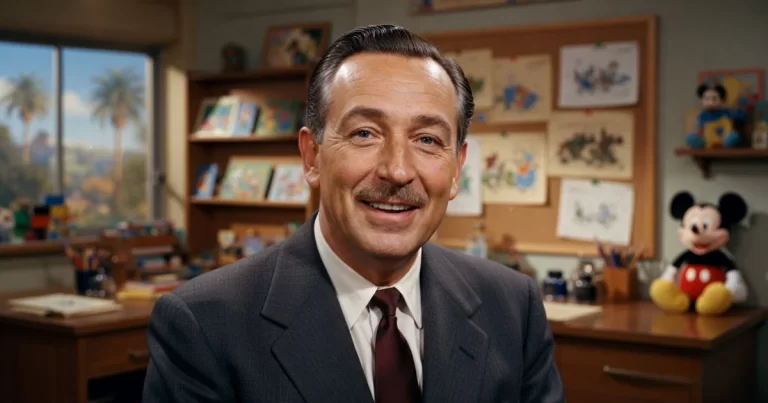
Walt Disney
Pioneering Animator And Entertainment Visionary
Walt Disney was a pioneering animator and entrepreneur who created Mickey Mouse and built a global entertainment empire that transformed animation and theme parks.
Explanation Of The Quote
It is easy, from a modern vantage point, to read this quote as quaint, the well-meaning sentiment of an earlier era when the relationship between media and young minds was less complicated than it is today. But sit with it a little longer and something more serious emerges. Walt Disney was not making a casual observation. He was articulating a philosophy that drove every creative and commercial decision his studio made, and that philosophy rested on a conviction he held with extraordinary seriousness: that what children watched was a form of education, whether anyone intended it to be or not.
The Studio as a Responsibility
Walt Disney grew up in a era before cinema had fully established itself as a mainstream cultural force, and he watched it become one in real time. He understood from early in his career that the screen had a kind of authority over young imaginations that no other medium had previously possessed. A book required effort and literacy. A radio programme required active listening. But a film surrounded you, filled your field of vision, gave faces and voices to characters that would live in your memory for decades. For a child, that experience was close to total.
This gave Disney a sense of responsibility that shaped his studio’s output in ways both obvious and subtle. The obvious ways are visible in the moral architecture of his films: good and evil are distinct, courage is rewarded, kindness matters, and the characters young audiences were meant to identify with consistently modelled the qualities Disney believed would serve them well as adults. These were not accidental choices. They were the result of a deliberate editorial philosophy applied to every project the studio undertook.
The subtler ways are visible in what Disney refused to produce. He was famously protective of the tone and content of his studio’s output, resisting pressure to introduce elements he felt were inappropriate for young audiences or that undermined the values he wanted his films to carry. This made him, at times, a difficult collaborator and an inflexible creative partner. But it also produced a body of work with a remarkable internal consistency, a sense that every film came from the same place and pointed in the same direction.
Ideals Embedded in Stories
The phrase “ideals and objectives of normal adulthood” in Disney’s quote deserves attention. He is not talking about propaganda or moral instruction in any heavy-handed sense. He is talking about something more organic: the way stories model a version of the world that young minds absorb and carry forward, shaping their intuitions about how people should treat each other, what courage looks like, what family means, what it feels like when justice is done.
Every significant Disney film of his era engaged with these questions. Bambi explored loss and the passage from innocence to responsibility. Pinocchio examined the consequences of dishonesty and the meaning of becoming real, of earning one’s full humanity through integrity. Dumbo offered a portrait of difference, mockery, and the vindication of an unlikely gift. These were not simple stories dressed up in animation. They were explorations of experiences that every child would eventually face, offered in a form that was safe, beautiful, and emotionally accessible.
Walt Disney believed that encountering these themes in the protected space of a story was genuinely useful preparation for encountering them in life. A child who had watched Bambi had, in some small but real way, been given a companion for the experience of grief. A child who had watched Pinocchio had been given a story about conscience that would not leave them easily.
A Standard That Holds
What makes this quote remarkable is not just its sincerity but its continuing relevance. The screens have multiplied enormously since Disney spoke these words, and the content available to young people is vastly more varied, more intense, and less curated than anything he could have imagined. But the underlying truth he identified has not changed at all. Stories still shape young lives. The images, values, and emotional experiences that children absorb through entertainment still contribute to the adults they become.
Walt Disney’s contribution was to take that truth seriously at a moment when he had the power and platform to act on it, and to build an institution whose founding purpose was to use the extraordinary influence of the screen in the service of something worthy. That is a harder thing to do than it sounds, and a rarer one than it should be.
Every story told to a child is a small act of world-building. Choose the material carefully.